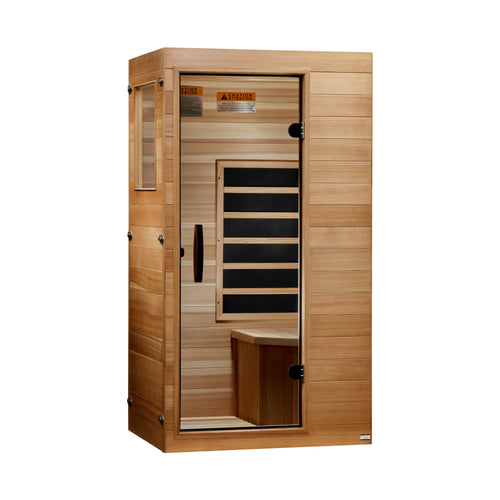

Do You Need an Electrician for an Infrared Sauna?
Plug-and-play vs hardwired, 120V vs 240V — and why most buyers never need to make the call.

This is the question that stalls more sauna purchases than any other. People picture a contractor, a permit, a hole in the wall, and a bill they can't predict — and quietly close the tab. So here's the good news, up front: for most infrared saunas, the answer is no. You plug it into the wall like a kettle and you're done.
But "most" isn't "all", so let's make it easy to tell which camp you're in before you order.
Plug-and-play vs hardwired
Plug-and-Play (120V)
- Plugs into a standard household outlet
- Set it up yourself — no wiring, no permits
- You can move it to another room later
- Zero added electrical cost
- Includes our $1,999 2-person best-seller
Hardwired (240V)
- Wired into your panel on a dedicated circuit
- Requires a licensed electrician
- One-time cost: roughly $150–$400
- Effectively permanent once installed
- Supports bigger cabins and more heaters
| Plug-and-play (120V) | Hardwired (240V) | |
|---|---|---|
| Typical models | Most 1–2 person saunas | Some 3–4 person models |
| Electrician needed | No | Yes — a licensed electrician |
| How it connects | Standard household outlet | Dedicated circuit wired into your panel |
| Added electrical cost | None | Roughly $150–$400, one time |
| Wiring or permits | None | Required |
| Move it later | Yes — it can go to another room | Effectively permanent once installed |
| Best for | Smaller cabins, including our $1,999 2-person best-seller | Bigger cabins and more heaters |
If it has a plug on the end of the cord, you don't need an electrician. It really is that simple.
How to tell which one you're buying
You never have to guess. The power requirement is a published spec on every model — but here's the 30-second version.
Check the product specs
Look for "120V" or "plug-and-play" — that's a standard outlet. "240V" or "dedicated circuit" means an electrician. Every model we list states this plainly.
Use capacity as a rule of thumb
1–2 person cabins are almost always 120V. 3–4 person cabins are where 240V starts appearing. If you're weighing sizes, our 2-person vs 4-person guide covers the trade-offs.
Look at the outlet you'll actually use
A standard 120V outlet is fine — but it should ideally be a dedicated one, not shared with other heavy appliances on the same circuit.
Still unsure? Just ask us
Tell us the model and the room, and we'll tell you exactly what it needs. That's a two-minute phone call, not a consultation.
One hard rule: no extension cords
A sauna pulls high current continuously for 30+ minutes. Extension cords and power strips aren't built for that — it's a genuine fire risk, and it can void your warranty. Plug the sauna directly into a wall outlet. If the outlet isn't where you need it, have an electrician add one; don't reach for a cord.
What if I do need the 240V circuit?
It's less dramatic than it sounds. A licensed electrician runs a dedicated circuit from your panel to the sauna's location — typically a one-time cost of about $150–$400, depending on the distance from your panel and local labour rates. It's a half-day job, not a renovation.
Still, it's a real cost worth folding into your budget before you commit. We break the full picture down — including the costs that surprise people — in our home sauna cost guide.
Before your sauna arrives, confirm:
- The outlet exists — and it's within reach of the cabin's cord, in the room where the sauna will live.
- It's not overloaded — avoid sharing a circuit with other high-draw appliances.
- The voltage matches the spec on your model (120V vs 240V).
- The room is indoors and dry — these cabins are indoor-only.
Whichever route you take, it's worth checking the EMF rating while you're reading the spec sheet. Wiring is a one-day decision; the heaters you sit beside are a ten-year one.
The Iridescent Home Team
Authorized dealer for Dynamic, Maxxus & Golden Designs. Tell us your model and your room and we'll confirm exactly what it needs. Call (307) 201-4597.
Plug it in. That's the install.
Our 1–2 person infrared saunas run on a standard outlet and assemble in about 60–90 minutes. From $1,499 — free shipping, the manufacturer warranty registered to you, and monthly payments (est. from $125/mo, 0–36% APR).
Not sure what your room needs? (307) 201-4597 · 9am–5pm MT, every day
Sauna electrical FAQ
Do I need a special outlet for an infrared sauna?
Can I plug my sauna into an extension cord or power strip?
Do I need a permit to install a home sauna?
Can I move a plug-and-play sauna later?
Electrical requirements vary by model — always follow the specifications and installation manual for your specific sauna, and use a licensed electrician for any dedicated-circuit work. Electrician cost estimates are typical ranges and will vary by location.