
If you've searched "how much does a home sauna cost," you're probably not looking for a number in a vacuum. You want to know what's actually different between a $1,499 model and a $3,500 one, whether the more expensive version is actually worth it, and what you'll actually spend per month once it's sitting in your spare room.
We're an authorized dealer for Dynamic, Maxxus and Golden Designs, and we've read the manufacturer's manual for every model we list — and the question we get most often isn't "what's your cheapest sauna?" It's this one: what do I actually get for my money? This guide answers that completely.
The Four Price Tiers Explained
Indoor infrared saunas break into four practical tiers based on capacity and specification. Here's what each tier gets you and where the real trade-offs are.
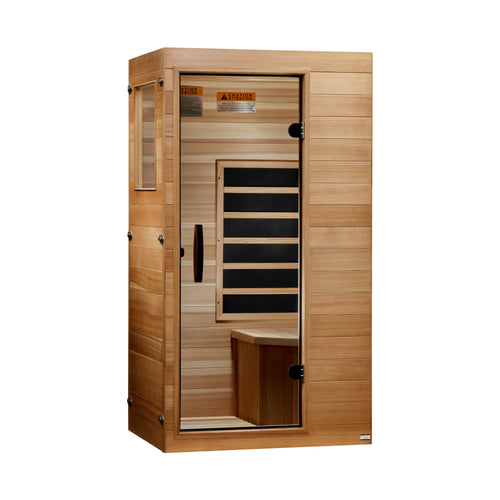
Best for solo recovery in smaller spaces.
Fits a 4×4 ft footprint. Standard 120V outlet. Assembly under 60 minutes.
- 1 person capacity
- FAR infrared heaters
- Ultra Low EMF rated
- Canadian Hemlock wood
- Chromotherapy lighting
- Warranty: 5 years on heaters and electronics, 1 year on the wood
The sweet spot for most households.
Fits a 4×6 ft footprint. Uses the same standard 120V outlet. You get nearly twice the bench space for an extra $500.
- 2 person capacity
- 8 FAR infrared carbon heaters
- Low or Ultra Low EMF
- Canadian Hemlock or Cedar
- Chromotherapy + Bluetooth
- Warranty: 5 years on heaters and electronics, 1 year on the wood
Near-Zero EMF, full spectrum, or premium 2-person builds.
For buyers who want the lowest possible EMF output, full spectrum wavelengths (near + mid + far), or Canadian Cedar construction.
- 2-person capacity
- Full spectrum or Near-Zero EMF
- Near + Mid + FAR wavelengths
- Premium Canadian Cedar wood
- Upgraded control panel
- Warranty: 5 years on heaters and electronics, 1 year on the wood
For dedicated wellness rooms and multi-person households.
Requires a 7×9 ft+ footprint. Some 3-person full spectrum models need a 240V circuit — always confirm before ordering.
- 3–6 person capacity
- Full spectrum heaters standard
- Near-Zero EMF ratings available
- Premium Canadian Cedar throughout
- Multiple wall-mounted heaters
- Warranty: 5 years on heaters and electronics, 1 year on the wood
| Price range | Finance from | What it is | |
|---|---|---|---|
| Tier 1 · 1-Person Compact | $1,499–$2,399 | $124/mo | Solo recovery in a small room; standard 120V outlet |
| Tier 2 · 2-Person | $1,999–$3,199 | $166/mo | The most popular choice; still 120V plug-and-play |
| Tier 3 · 2-Person Elite / Full Spectrum | $2,199–$4,599 | $183/mo | Near-zero EMF, full spectrum, or premium 2-person builds |
| Tier 4 · 3–6 Person | $2,799–$7,599 | $233/mo | Family and larger cabins; typically 240V hardwired |
What most buyers actually choose
Our best-selling sauna isn't the biggest model on the floor — it's the $1,499 one-person compact. Most first-time buyers start at the entry tier, confirm the daily habit sticks, and size up later.
The cheapest sauna you'll actually use every day beats the impressive one you talk yourself out of.
What Actually Drives the Price
Capacity is the biggest single factor — but it's not the only one. Here's what moves the number:
1. Heater Type: FAR vs. Full Spectrum
FAR infrared (wavelengths 5–14 microns) is what most residential saunas use. It penetrates soft tissue effectively and is the most-researched wavelength for recovery and cardiovascular benefits. Full spectrum saunas add near-infrared and mid-infrared wavelengths — near-infrared is linked to skin and cellular health, mid-infrared is associated with joint and muscle penetration. Full spectrum models run $200–$600 more than comparable FAR-only models.
2. EMF Rating
All modern infrared saunas operate at low EMF. The tier labels refer to the reading at the heater panel itself — the highest-exposure point. Readings drop sharply by the time you're on the bench a few inches away:
- Low EMF: Roughly 5–10 milligauss at the panel. The baseline for reputable brands.
- Ultra Low EMF: 3–5 milligauss at the panel — Dynamic's Elite line. Adds $100–200 over equivalent Low EMF models.
- Near-Zero EMF: Under 3 milligauss at the panel; select Maxxus models rate under 2. Typically adds $300–500.
For context: a hair dryer emits 60–20,000 milligauss at its surface, and a microwave 100–300 milligauss at the door. Even standard Low EMF is already conservative by everyday-appliance standards — Near-Zero EMF is for buyers who want the absolute minimum regardless of comparison.
3. Wood Species
Most entry and mid-range saunas use Canadian Hemlock — a dense, odor-neutral softwood that handles heat and humidity well. Premium models use Canadian Red Cedar, which is naturally antimicrobial, more aromatic, and more resistant to warping over years of daily use. Cedar construction adds $200–400 at comparable spec levels.
4. Brand and Dealer Status
The brands we carry — Dynamic, Maxxus, and Golden Designs — are all manufactured to similar standards and share many of the same heater components. Where pricing diverges is not the brand itself: it's what the seller does after the delivery. Non-specialist resellers can and do list lower. What you give up is not the warranty — Golden Designs' own terms attach it to the original purchaser at the original installation site, with your sales receipt as proof, wherever you bought it — it's the service wrapped around it. The manufacturer routes support back through the seller, and repairs by non-authorized personnel void the coverage, so who arranges the repair is the thing you are actually paying for. At $2,000+, that distinction is worth pricing.
"The warranty follows the receipt, not the storefront. What changes in year three is who picks up the phone and gets the part moving — Golden Designs' own terms send you back to whoever sold it."
Not sure which tier is right for your space?
Answer 7 questions about your room dimensions, health goals, and budget. We'll recommend the exact model — from 27 options across all four tiers.
Find My Perfect SaunaThe Costs Nobody Mentions (Mostly $0)
A sauna is unusual for a major home purchase: with a 120V plug-and-play model, the sticker price is essentially the whole price. The "extras" that add thousands to a kitchen remodel mostly don't exist here.
- Delivery — $0. Free curbside freight on every order. The carrier calls ahead to schedule a window.
- Installation — $0. Clasp-together assembly in 60–90 minutes with a helper — no special tools. "Took longer to unpack than to put together." — Angie B., verified buyer.
- Electrical work — $0–$400. $0 for most models on a standard 120V outlet. Some larger 3–4 person units need a dedicated 240V circuit — a one-time $150–$400 electrician cost, always listed in the product specs.
What Does a Home Sauna Cost to Run?
The purchase price is a one-time cost. Your electricity bill is not. Here's what a FAR infrared sauna actually costs to operate:
1,500W
Typical draw for a 2-person FAR infrared sauna during use
$0.13
Average cost per 45-minute session (at $0.17/kWh national average)
~$15/mo
Added to your electric bill if you use it 4×/week
The math: at 4 sessions per week, you're looking at roughly $12–20 per month added to your electricity bill. That includes pre-heat time. Larger 3+ person models pull more power (up to 2,400W), putting you closer to $25–35/month at the same frequency.
Want your exact number instead of an average? Use our free sauna running-cost calculator — it factors in your electricity rate and session habits — or read the full breakdown of what an infrared sauna costs to run.
Electrical requirements: Most 1 and 2-person FAR infrared saunas run on a standard 120V, 15-amp household circuit — the same outlet your dryer doesn't need and your spare bedroom already has. Full spectrum models and 3+ person units sometimes require a dedicated 240V circuit. Always confirm before ordering, or call us: (307) 201-4597.
Is a Home Sauna Worth the Cost?
The question behind this question is usually: am I spending $2,000 on something I'll use once a week for a month and then ignore? That's a fair concern. Here's the honest answer.
Our customers average 4 sessions per week at the 6-month mark. Unlike a treadmill or a Peloton, a sauna session is something people look forward to — not something they have to motivate themselves for. You don't "work out" in a sauna. You sit down, close the door, and feel better for 30 minutes. That's a different kind of barrier.
The financial comparison looks like this:
Home Sauna vs. Spa Access — 5-Year Cost
$26,000
Spa sessions (2×/week × $50/session × 5 years)
$2,899
Home sauna purchase + 5 years of electricity
Based on a $1,999 sauna + $15/month electricity. At 4 sessions/week it matches that spa spend in under 8 weeks; at 2 sessions/week, in under 5 months. Use our full calculator →
Even if you only use it twice a week, the math still works inside a single year. The real question is whether you'll actually use it — which is why the quiz below asks about your routine before it recommends anything.
Free Download
Get the Complete Infrared Sauna Buying Guide
26 pages covering every spec that matters, the questions to ask before you buy, and a side-by-side comparison of every model we carry. No fluff.
No spam. One confirmation email, then the guide. Unsubscribe anytime.
Our Top Picks at Every Price Point
These are the specific models we recommend most often, based on 397 verified reviews across the models we carry. All prices include free shipping. All models are in stock.
$1,499
$124/mo
Dynamic Sicily — 1-Person Compact
Best entry-level solo sauna · Ships in 1–2 days
View Full Details →$1,999
$166/mo
Dynamic Gracia — 2-Person
Most popular in our catalogue · 31 reviews · 4.71 stars
View Full Details →$2,199
$183/mo
Dynamic Barcelona Elite — 2-Person Ultra Low EMF
Best seller · 33 reviews · 4.85 stars
View Full Details →$2,399
$199/mo
Maxxus Seattle — 2-Person Low EMF
Top-rated in our catalogue · 51 reviews · exceptional build quality
View Full Details →$3,999
$333/mo
Dynamic Lugano — 3-Person Full Spectrum
For dedicated wellness rooms and families
View Full Details →One More Consideration: the Cold Plunge
More buyers are pairing their infrared sauna with a cold plunge — and for good reason. The combination of heat and cold (contrast therapy) is what Dr. Andrew Huberman's work on the protocol documents: alternating between the two amplifies the cardiovascular benefits, sharpens mental clarity, and accelerates muscle recovery more than either alone.
Our cold plunge options start at $499 for the Dynamic Inflatable Oval — a practical entry point if you want to test contrast therapy before committing to a hard-shell unit. Full-size stainless steel tubs run $3,399–$6,099, and an active chiller adds $3,399–$3,599. If you're already spending $1,999 on a sauna, the $499 inflatable cold plunge is worth adding to the conversation.
Frequently Asked Questions
At 4 sessions per week (30–45 minutes each), a 2-person FAR infrared sauna adds approximately $12–20 per month to your electricity bill at average US rates ($0.15–0.17/kWh). A 3-person or full spectrum model pulls more power and will run $20–35/month at the same frequency.
Over 5 years of daily use at $15/month, that's $900 in electricity costs — added to your purchase price, still a fraction of what spa memberships cost over the same period.
The Dynamic Sicily at $1,499 is the entry point we're comfortable recommending. Below that price range, you start seeing ceramic heaters (which run hotter and less efficiently than carbon heaters), lower-grade wood, and unreliable warranty support.
The $1,499 model includes Ultra Low EMF carbon heaters and the manufacturer's warranty — 5 years on the heating elements and electronics, 1 year on the wood structure — and ships from an authorized dealer, so if a heater fails in year 3 there is someone to call who can actually get the part moving.
No, for most models. 1 and 2-person FAR infrared saunas run on a standard 120V household outlet — no electrician, no dedicated circuit, no special installation. You assemble it in your spare bedroom and plug it in.
Full spectrum 3-person and larger models sometimes require a 240V circuit (similar to a dryer outlet). If your space doesn't have one, that's a $200–400 electrician job. We flag the electrical requirements on every product page, and our team will confirm yours before you order — call (307) 201-4597.
With normal use and minimal maintenance, a well-built infrared sauna will last 10–20 years. The cabinet (wood structure) typically outlasts the heaters, which is why the warranty on the heating elements specifically matters more than the cabinet warranty.
On the Dynamic, Maxxus and Golden Designs infrared saunas we sell, the manufacturer covers the heating elements and electronics for 5 years and the wood structure for 1, in residential use. It is the heater figure that matters, because the cabinet normally outlives the heaters. Check which component a number refers to before you compare two warranties — they are often quoting different parts.
FAR infrared is the right choice for most people — it's the most-researched wavelength for cardiovascular benefits, recovery, and relaxation. The clinical literature that Dr. Andrew Huberman and others reference is primarily on FAR infrared heat exposure.
Full spectrum adds near-infrared (associated with skin and cellular health) and mid-infrared (often cited for deeper joint and muscle penetration). If skin health and anti-aging benefits are a primary goal, or you want the most comprehensive wavelength coverage, full spectrum is worth the premium. If your goals are recovery, sleep, and stress, FAR infrared delivers them at 20–40% less cost.
Yes — and the research is more rigorous than most wellness products. A 2015 JAMA Internal Medicine study followed 2,315 Finnish men over 20 years and found that men who used a sauna 4–7 times per week had a 40% lower risk of all-cause mortality versus once-weekly users. The cardiovascular and blood pressure benefits have been replicated across multiple studies.
Dr. Andrew Huberman has discussed the protocol specifics on his podcast — 57–83°C for 15–30 minutes per session, ideally multiple times per week. The research on recovery, cortisol reduction, and growth hormone response is solid. This isn't a wellness trend. The evidence base goes back decades.
Sometimes — Golden Designs distributes to Costco, so it really is the same brand. When a model is in Costco's rotation it often lists below our price, and we would rather say so than pretend otherwise.
What you don't give up there is the warranty: Golden Designs' terms cover the original purchaser at the original installation site, with your sales receipt as proof, wherever you bought it. What you give up is the handling. The manufacturer routes customer service back through the seller, repairs by non-authorized personnel void the coverage, and a warehouse club is not set up to diagnose a heater or arrange a freight replacement for you. That is the part you are buying from us. We also price match other authorized dealers: if you find the identical model in stock and advertised for less by another authorized dealer, tell us within 30 days of your purchase and we'll match that price. A price match can't be combined with a discount code.
Quick rule of thumb: under 5×5 ft available → 1-person. 5×7 ft → 2-person. 7×9 ft+ → 3-person.
But the more important question is how you'll use it. Two-person saunas are popular for solo use — you get a full bench to lie down, space to stretch, and a fundamentally different experience from a compact 1-person unit. If budget allows, most solo buyers step up to the 2-person tier and don't regret it.
If you want a 5-minute answer specific to your exact room measurements, call us at (307) 201-4597 and we'll pull up your clearance dimensions immediately. Or take our 7-question quiz for an instant recommendation.
Ready to Move Forward?
Find Your Sauna in 60 Seconds
Answer 7 questions. We'll match you to the right model from 27 options — with sizing, electrical requirements, and a recommendation you can act on today.