The Sauna Buyer's Glossary
Every term you'll meet while shopping for an infrared sauna — heater types, EMF tiers, wood, and wavelengths — explained without the jargon, by an authorized dealer.
Carbon vs ceramic · Far infrared vs full spectrum
Carbon vs Ceramic
Carbon panels emit gentle, even far infrared across a large flat surface, run cooler, and usually produce lower EMF. Ceramic rods run hotter in concentrated spots and heat faster, but less evenly. Most modern low-EMF saunas — including everything we carry — use carbon panels.
Far Infrared vs Full Spectrum
Far infrared uses the longest wavelength to warm you directly at comfortable temperatures — the best value and ideal for daily recovery. Full spectrum adds near and mid infrared for the broadest therapeutic range, at a higher price, usually with near-zero EMF heaters.
Every term, defined
- Far Infrared (FIR)
- The longest infrared wavelength used in saunas. It penetrates the body to warm it directly at gentle temperatures (120–150°F), which is why far-infrared saunas feel comfortable for longer sessions.
- Full Spectrum Infrared
- A heater emitting near, mid, and far infrared together for the broadest therapeutic range. The highest-spec option, typically paired with near-zero EMF heaters.
- Carbon Heater Panel
- A large flat panel that emits even, low-intensity far infrared across a wide surface. Runs cooler, heats evenly, and generally produces lower EMF than ceramic.
- Ceramic Heater
- A rod or coil heater that runs hotter in concentrated spots with shorter, more intense infrared. Heats fast but less evenly; more common in older or budget designs.
- Low EMF
- Panels engineered to keep electromagnetic field output to ~5–10 mG at the surface. Ultra Low is 3–5 mG; Near Zero under 3 mG at the panel. See our low-EMF guide.
- Milligauss (mG)
- The unit for measuring EMF strength — lower is better. A low-EMF sauna panel reads 5–10 mG at 2–3 inches; a hair dryer reads 60–20,000 mG.
- Canadian Hemlock
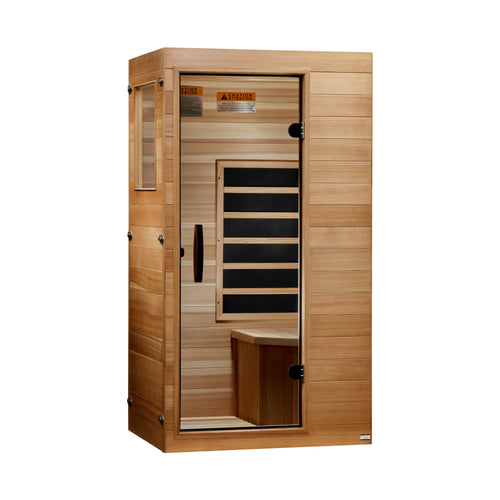
- A pale, fine-grained, low-resin softwood used for most infrared cabins. Resists warping, has little odor, and tolerates heat well.
- Chromotherapy
- Color light therapy built into many sauna interiors, often paired with a red light therapy feature, said to support mood and relaxation.
- Plug-and-Play (120V)
- Runs on a standard household outlet, no electrician needed. Most 1–2 person saunas qualify; larger 3+ person units may need a dedicated 240V circuit.
- Löyly
- The burst of steam from water poured over hot rocks in a traditional sauna. Infrared saunas use dry heat and don't produce löyly. See infrared vs traditional.
Quick answers
What is the difference between carbon and ceramic infrared sauna heaters?
Carbon heaters are large flat panels that emit gentle, even far infrared across a wide surface, run cooler, and generally produce lower EMF. Ceramic heaters are rods or coils that run hotter in concentrated spots and heat up faster, but distribute heat less evenly. Most modern low-EMF saunas use carbon panels; ceramic is more common in older or budget units.
What is the difference between far infrared and full spectrum saunas?
A far-infrared sauna emits only the longest infrared wavelength, which warms the body directly at comfortable temperatures — ideal for everyday recovery and the best value. A full spectrum sauna emits near, mid, and far infrared together for the broadest therapeutic range, and is the higher-spec, higher-priced option, usually paired with near-zero EMF heaters.
What does low EMF mean on a sauna?
Low EMF means the heating panels are engineered to keep electromagnetic field output low — typically 5–10 milligauss (mG) at the panel surface, well below appliances like hair dryers and microwaves. Ultra Low EMF panels read 3–5 mG and Near Zero EMF reads under 3 mG at the panel.
Ready to find your match?
Answer 7 quick questions and we'll recommend the right model for your space, budget, and EMF preference — free shipping and a 5-year warranty, as an authorized dealer.
Questions? (307) 201-4597 · 9am–5pm MT, every day