Carbon vs Ceramic Infrared Heaters: Which Should You Buy?
The heater type shapes how your sauna feels, how quickly it warms up, and how much EMF it produces. Here is an honest comparison — without the marketing spin.

When you start shopping for an infrared sauna, you will run into two heater types — carbon and ceramic — and a lot of marketing language that makes choosing between them sound more complicated than it is. The short answer: carbon panels are what most people should buy. But "most people" is not everyone, and understanding why will help you spend your money in the right place.
Both carbon and ceramic heaters produce far-infrared radiation, the long-wave infrared that warms your body directly rather than superheating the air around you. The difference is in how they are built, how that affects the heat you feel, the EMF they emit, and how they hold up over years of daily use.
How each heater works
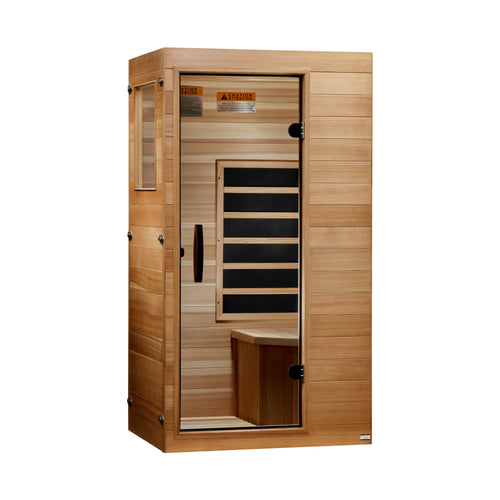
Carbon panels are thin, flat sheets — usually a carbon-fibre composite — mounted across a large surface area inside the cabin. Because the panel is big and runs at a relatively low surface temperature, it can warm the whole interior evenly, including the floor area near your feet. Carbon panels produce longer far-infrared wavelengths, which many people describe as a deep, enveloping warmth rather than intense surface heat.
Ceramic heaters are compact rods or tubes made from a ceramic compound. They reach a higher surface temperature than carbon panels, which means they produce intense, focused heat. Most ceramic sauna cabins position several rods to cover the back and side walls. The heat is effective but can feel more directional — you will notice the concentrated warmth from each element rather than an even ambient temperature.
Carbon panels heat the whole room; ceramic rods heat the parts of the room they face. Both will give you a good sweat — the difference is how that feels in practice.
Side-by-side: the six things that actually matter
| Factor | Carbon Panels | Ceramic Rods |
|---|---|---|
| Warm-up time | Faster — typically 10–15 min | 15–25 min to full temp |
| Heat distribution | Even — wall-to-wall, floor to ceiling | Directional — strongest near each rod |
| EMF output | Lower — large panel, low watt density | Higher surface temp = higher EMF typical |
| Infrared wavelength | Far-infrared (6–14 microns) | Far-infrared (similar range) |
| Heat intensity feel | Gentle, enveloping | Intense — preferred by some users |
| Durability | No fragile parts — flat panel | Glass-ceramic rod; can crack if impacted |
The EMF question
EMF is the dimension where carbon heaters have the clearest advantage, and it is worth explaining why. A carbon panel covers a large area and runs at a lower watt density to produce the same infrared output a smaller, hotter ceramic rod would need to produce from a compact point. Lower watt density at the surface means a lower electromagnetic field radiating from that surface.
This is why almost every sauna marketed as "low EMF" or "near-zero EMF" uses carbon panels — the physics make it the natural low-EMF format. It does not mean ceramic heaters are unsafe; it means carbon panels make achieving a low reading easier, and the best-performing certified saunas tend to use carbon technology. If EMF is a priority for you, our low-EMF sauna guide explains how to read the numbers and what a genuinely low reading looks like.
Who should consider ceramic?
Ceramic heaters still have genuine advocates, and not without reason. Some experienced sauna users prefer the more intense, focused heat — the feeling of the warmth coming from a specific source rather than an ambient glow. If you have used a traditional high-temperature sauna and want to get as close to that intense-heat feel as possible while still using an infrared cabin, a ceramic heater may suit you better than a carbon panel.
Ceramic heaters are also often found on older or entry-priced cabins, and if you are buying used or looking at a deeply discounted model, ceramic is not a reason to walk away — it is simply a different experience.
Carbon is the better fit if you…
- Want even heat with no hot spots
- Want a shorter warm-up time
- Prioritise low or near-zero EMF
- Plan to use it daily for years
- Are new to infrared saunas
Ceramic may suit you if you…
- Prefer intense, directional heat
- Have prior experience with hot traditional saunas
- Are buying a discounted or used cabinet
- EMF is not a key concern for you
What about full-spectrum heaters?
You will also see "full-spectrum" listed as a heater type. Full-spectrum heaters add near-infrared and mid-infrared wavelengths on top of the standard far-infrared output. Most carbon and ceramic heaters produce only far-infrared.
Near-infrared penetrates the skin shallowly and is the same wavelength used in red-light therapy panels. Mid-infrared sits between near and far. Whether the added wavelengths matter to you depends on why you want the sauna. For general wellness, relaxation, and the heat experience most people describe, far-infrared alone is what most buyers use and are satisfied with. Full-spectrum models cost more; they are worth the upgrade if you specifically want the broader wavelength range — not because "more infrared types" is automatically better.
If you are weighing full-spectrum against far-infrared more carefully, look for the specific wavelength specs on each product page — or call our team and we can walk you through the options for your goals.
The one-paragraph verdict
For most buyers: carbon panels. They warm up faster, heat the room more evenly, and are the natural low-EMF format. Every Dynamic, Maxxus, and Golden Designs model we carry uses carbon panel technology — it is the industry standard for good reason.
If you specifically want an intense, concentrated heat and EMF is not a concern, a ceramic model can deliver that experience. But for daily wellness use — relaxation, recovery, heat therapy — carbon panels make the session more comfortable and are the safer long-term investment.
What you will find in our catalog
All of the infrared saunas we carry use carbon far-infrared panels as their primary heating element. Entry-level models like the Dynamic Sicily 1-person start at $1,499 with free shipping; the popular Dynamic Gracia 2-person is $1,999. Both carry the manufacturer's warranty — 5 years on the heating elements and electronics in residential use, 1 year on the wood — and both are available on monthly payments through Shop Pay (0–36% APR, subject to an eligibility check). If you want to understand how to read the EMF specs across our range, the low-EMF guide covers the numbers in plain language.
The Iridescent Home Team
Authorized dealer for Dynamic, Maxxus & Golden Designs — three brands that put carbon panels and published EMF specs into every cabin. Questions about which model fits your space? Call (307) 201-4597, 9am–5pm MT, every day.
Infrared saunas built on real heater tech
Every model in our catalog uses carbon far-infrared panels with published EMF ratings. From $1,499 — free shipping, the manufacturer's warranty registered to you, and monthly payments through Shop Pay (0–36% APR).
Questions? (307) 201-4597 · 9am–5pm MT, every day
Carbon vs ceramic heater FAQ
Is one heater type actually healthier than the other?
Can I tell which heater type a sauna uses before buying?
Do ceramic heaters burn out faster?
What is the difference between carbon and carbon-ceramic hybrid heaters?
This article is general wellness information only and has not been evaluated to diagnose, treat, cure, or prevent any disease. Consult your healthcare provider before starting sauna use if you have a medical condition.