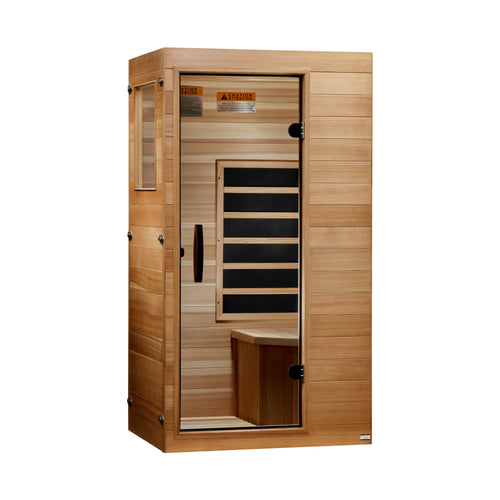

Garage Sauna or Basement Sauna? What the Manuals Require
Most home saunas end up in a room that was never built for one. We read the owner's manuals behind the saunas we sell to see what a garage or basement install really needs — power, temperature, damp and headroom — and which cabins fit.

The garage and the basement are where a lot of home saunas go: space nobody is using, a hard floor, and no argument about giving up the spare bedroom. Both can work well. But a garage sauna or a basement sauna runs into four conditions the product photos never show — and the manufacturers write every one of them down.
We sell 101 indoor saunas from Dynamic, Maxxus and Golden Designs, and we've read the owner's manuals behind them. This is what they say about garages and basements, and which cabins suit which space.
The short version
- Its own circuit. Even the plug-in cabins' manuals open with "120VAC 15AMP Dedicated Circuit Required". Most 3–4 person cabins need a dedicated 120V/20A circuit; traditional stoves need 240V.
- No GFCI, no extension cord. 23 of the manuals warn against a GFCI-protected circuit, and every one rules out extension cords and adapters. Garage outlets are normally GFCI-protected — so plan on an electrician.
- Not below 60°F. 38 manuals advise against using the sauna in a room colder than 60°F, and many more say a cold room slows the preheat.
- Not a wet basement. Every Dynamic and Maxxus manual, and most Golden Designs manuals, say not to install the sauna in a wet basement or near water.
- Measure the headroom. Our indoor cabins stand 65 to 87 inches tall; most are 73 to 77.
1. Power: why the garage outlet won't do
Half of our indoor saunas — 50 of 101 — come with an ordinary 120V plug, which makes them sound like something you can plug in anywhere. The manuals are stricter. The ones for our plug-in cabins open with the same line: "120VAC 15AMP Dedicated Circuit Required." A dedicated circuit means nothing else on it — not the freezer, not the garage door opener, not the shop vac.
| What the cabin needs | Cabins | Typically |
|---|---|---|
| 120V/15A plug, on its own circuit | 50 | 1–2 person infrared cabins |
| One dedicated 120V/20A circuit | 33 | 3–4 person infrared cabins |
| Two dedicated 120V circuits | 6 | Large infrared cabins, such as the 6-person Monaco |
| A 240V circuit (30A or 40A) | 12 | Indoor traditional and hybrid saunas, and the 8-person infrared cabins |
Our 101 indoor saunas, from the electrical line on each product page and the owner's manual. The manual for your model is authoritative — it's linked on every product page.
The GFCI problem
The second rule surprises people. Dynamic's manuals put it bluntly: "Unfortunately, our saunas cannot be connected to a GFCI due to the amount of power the sauna uses." The troubleshooting tables in the Maxxus and Golden Designs manuals say the same thing more politely — a GFCI-protected outlet or breaker "is not recommended", and the fix is to replace it with a non-GFCI one.
That collides with how garages are wired. Electrical codes generally require GFCI protection on garage outlets, and in many areas on basement outlets too. It isn't a reason to give up on the garage. It's the reason the circuit is an electrician's job: a licensed electrician can reconcile your local code with the manufacturer's requirement, and it is far easier to settle before delivery than after the sauna starts tripping.
A sauna with a household plug is not a sauna that can use any household outlet. The manual decides, and it wants a circuit of its own.
And one rule has no exceptions at all: every manual we read prohibits extension cords and plug adapters between the sauna and the wall. If the outlet isn't where the sauna needs to stand, have an electrician put one there.
2. Temperature: the 60°F line
Garages are cold for a large part of the year, and the manuals notice. Thirty-eight of them say, in almost identical words: "It is not recommended to use the sauna in an environment with an ambient temperature below 60°F." Many more warn that if the room is below about 68–72°F, the sauna will take longer to preheat. Several put a normal preheat at roughly 20 to 30 minutes to reach about 118°F — from a room at normal indoor temperature.
So if your garage drops below 60°F in winter — and an unheated one often will — you have three honest choices: insulate and heat the space, put the sauna somewhere that stays warmer, or treat it as a three-season sauna. A basement that holds a steady indoor temperature is often the easier room on this count.
3. Damp: the basement dealbreaker
The line that decides most basement installs appears in every Dynamic and Maxxus manual and in most of the Golden Designs ones: "Do not install the sauna near water, near a bathtub, near a shower, in a wet basement, or near a swimming pool." Golden Designs' manuals add that the sauna should stand in a well-ventilated area with its vents unobstructed.
If your basement takes on water, or only stays dry because a dehumidifier runs all summer, solve that first or choose another room. A dry, finished basement is one of the better places in a house for a sauna. A damp one is on the manufacturer's list of places not to put it.
4. Headroom and the floor
Ceiling height is the basement detail people discover on delivery day. Our indoor cabins stand 65 to 87 inches tall: the compact 1-person Dynamic Sicily is 65″, most 2–4 person cabins are 73–77″ (every Maxxus is 75″), and the indoor traditional cabins run up to 83″. Measure to the lowest point you'll build under — beams, ducts and pipes included — and leave working room above. The manuals have you lift the roof panel up and onto the walls during assembly, which needs clearance of its own.
The floor matters in both rooms. Golden Designs' manuals ask for a surface that is level, dry and able to carry the sauna and its occupants. Garage slabs are often poured with a slight fall toward the door so water drains out, so put a level on the exact spot before delivery, not after.
Which saunas suit a garage or basement


| Model | Seats | Outside height | Circuit (per manual) | Wood | Price |
|---|---|---|---|---|---|
| Dynamic Sicily | 1 | 65″ | 120V/15A dedicated | Cedar | $1,499 |
| Dynamic Vero | 1 | 67″ | 120V/15A dedicated | Cedar | $1,599 |
| Dynamic Barcelona | 1–2 | 73″ | 120V/15A dedicated | Hemlock | $1,999 |
| Dynamic Cordoba | 2 | 75″ | 120V/15A dedicated | Hemlock | $2,199 |
| Maxxus Seattle | 2 | 75″ | 120V/15A dedicated | Hemlock | $2,399 |
| Dynamic Lugano | 3 | 75″ | 120V/20A dedicated | Hemlock | $2,799 |
| Maxxus Montilemar | 3 | 75″ | 120V/20A dedicated | Hemlock | $2,999 |
| Dynamic Bergamo | 4 | 75″ | 120V/20A dedicated | Hemlock | $3,399 |
| Golden Designs Sundsvall (traditional) | 2 | 83″ | 240V/30A stove + 120V/15A | Cedar | $6,099 |
Outside heights from the product listings; circuits from each model's owner's manual. Prices as listed at the time of writing — the product page is authoritative.
- Low basement ceiling: the 1-person Sicily (65″) and Vero (67″) are the shortest cabins we sell, and both are cedar.
- Two people, simplest wiring: a 2-person cabin on a dedicated 15A circuit, such as the Cordoba or Seattle.
- A family garage sauna: 3–4 person cabins like the Lugano or Bergamo need one dedicated 20A circuit — still 120V.
- Real stove heat indoors: an indoor traditional sauna needs 240V and more headroom — see our indoor traditional sauna guide.
The warranty: "indoor" means indoor
The Dynamic and Maxxus warranties run 1 to 5 years by component — 5 years for residential use on the heating elements and electronics, and 1 year on the wood structure — and the warranty text on the Dynamic, Maxxus and Golden Designs infrared cabins is unambiguous about location: "This sauna is for INDOOR use only. Placing your sauna outdoors will VOID this warranty." A garage or a basement is indoor space. An open carport, a porch or a pergola is not, and that clause makes the difference expensive. If the plan involves anything with fewer than four walls, call us before you order.
Before you order — the short list
- Read the circuit line in the manual for your model, and get that circuit quoted — including the GFCI question and your local code.
- Check the room's winter temperature. Below 60°F is outside what 38 of the manuals recommend.
- Rule out damp. No wet basements, and nowhere water can reach the cabin.
- Measure the lowest point of the ceiling against the outside height, and leave room to lift the roof on.
- Check level exactly where the sauna will stand.
- Walk the route in — doors, stairs, turns. Freight arrives at the curb, so read our freight delivery guide, and see what the manuals say about assembly.
Tell us the room, the ceiling height and what your panel looks like, and we'll tell you which cabins fit — including when the honest answer is a different room.
The Iridescent Home Team
We are an authorized dealer for Golden Designs, Dynamic and Maxxus saunas, and every product page links the manufacturer's owner's manual. Planning a garage or basement sauna? Call (307) 201-4597, 9am–5pm MT.
Indoor saunas, fully specified
Outside dimensions, circuit requirements, the owner's manual and the full warranty text are on every model, so you can check the room before anything ships.
Questions? (307) 201-4597 · 9am–5pm MT
Garage and basement sauna FAQ
Can you put a sauna in a garage?
Can an infrared sauna go in a basement?
Does a garage sauna need a dedicated circuit?
Can I plug a sauna into a GFCI outlet?
How cold is too cold for a garage sauna?
How much ceiling height do I need?
This article is general information, not medical or electrical advice. High-heat bathing is not suitable for everyone — talk to your doctor before using a sauna if you are pregnant, have a heart condition or low blood pressure, or take medication that affects heat tolerance. Circuit, placement and warranty details above are taken from the manufacturers' published owner's manuals and warranty text for the models we sell; they vary by model, and the manual for your model is authoritative. All electrical work must be carried out by a licensed electrician to local code. Call (307) 201-4597 with any question before you order.