Round, Square or Rectangular? Choosing a Fire Pit Table Size and Shape
The shape decides how people sit around the fire. The size decides whether the patio still works. And one number most buyers assume grows with the table — the heat rating — often does not.

A fire pit table is furniture that happens to burn. Get the shape wrong and the seating never quite settles around it; get the size wrong and the patio becomes an obstacle course. Because a cast concrete table weighs anywhere from about 50 to over 200 pounds before it is crated, and needs a gas connection once it is in place, it is also not something you will casually move around to try a different arrangement.
So this guide works from the outside in: the space, then the seating, then the shape and size that fit both. The examples are the eleven Dekko concrete fire pits we sell, because every one of them publishes the dimensions, burner and BTU figures you need to compare.
Step one: mark it out before you shop
The most reliable sizing tool is a roll of masking tape. Mark a candidate footprint on the patio, then bring out the chairs, sofa or benches you will actually use and arrange them around it. Sit down. Can you reach a drink? Can someone walk behind the chairs? Is there still a clear route to the door or the garden? Do this for two sizes and the right one is usually obvious within ten minutes.
While you are out there, look up. Every concrete fire pit we sell carries the same published placement rule: 84″ of overhead clearance, with solid structure or combustible material on no more than two sides. If the spot is under a pergola, a porch roof or tree branches, read our overhead clearance guide before you choose a size — a rule that rules out the spot rules out every size with it.
Choose the seating first and the fire second. A table that fits the chairs you own beats a beautiful one you have to rearrange the garden for.
The three shape families


Round and bowl
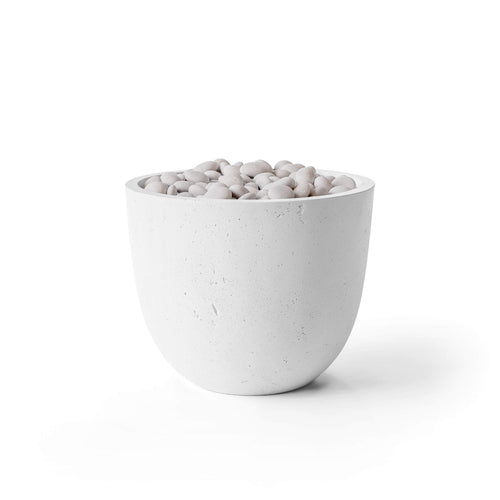
Round shapes suit a circle of individual chairs, where everyone faces the flame and nobody sits at an end. They also tuck into a corner well. In the concrete range there are three distinct forms: the Element, a small cupped bowl just over 20 inches across; the Serenade, a broad, shallow basin in 32″ and 40″ sizes; and the Belmont, the one true cylinder, at 36″.
Square
A square does the same social job as a round — seating on all four sides — but its edges line up with square paving, decking boards and a square arrangement of lounge chairs, which can make a small patio feel more ordered. The Alea is the plain square, in 32″ and 40″; the Bravo shares the 32″ footprint with a sculpted, concave centre.
Rectangular
Rectangular tables are the choice when the seating is a sofa, a sectional or a long bench. People sit along the long sides, and the flame runs the length of the table so everyone gets a share of it. The Avera (48″ and 60″, 25-3/4″ deep) is the slimmer of the two; the Sonoma (56″ and 72″, 30–33″ deep) is the anchor piece a large terrace is arranged around.
Every size, in one table
| Model | Shape | W × D × H | Weight* | From |
|---|---|---|---|---|
| Element | Round bowl | 20-1/2″ × 16″ H | 50 lb | $3,164 |
| Serenade 32 | Round basin | 32″ × 16″ H | 90 lb | $4,023 |
| Belmont | Cylinder | 36″ × 16″ H | 120 lb | $4,761 |
| Serenade 40 | Round basin | 40″ × 19″ H | 115 lb | $5,531 |
| Alea 32 | Square | 32″ × 32″ × 13″ | 115 lb | $4,023 |
| Bravo | Square | 32″ × 32″ × 13″ | 115 lb | $4,023 |
| Alea 40 | Square | 40″ × 40″ × 16″ | 177 lb | $5,206 |
| Avera 48 | Rectangular | 48″ × 25-3/4″ × 16″ | 145 lb | $4,971 |
| Avera 60 | Rectangular | 60″ × 25-3/4″ × 16″ | 175 lb | $5,416 |
| Sonoma 56 | Rectangular | 56″ × 30″ × 16″ | 190 lb | $5,698 |
| Sonoma 72 | Rectangular | 72″ × 33″ × 16″ | 215 lb | $6,380 |
*Weight before crating, as published on each product page. "From" prices are the starting configuration; finish, fire media and ignition change the final figure. The product page is authoritative — check there before ordering.
One thing the heights tell you: these are low-profile fire pits, 13 to 19 inches tall, made to sit among lounge seating. If you are picturing a table you eat dinner at with a fire in the middle, that is a different, taller category — and worth ruling in or out before you measure anything.
The heat question: size does not set the rating
This is the part most buyers get wrong. It feels intuitive that a 72-inch table puts out more heat than a 20-inch bowl. On the published figures, that is only true on one of the two ignition types.
| Model | Burner | Match lit | Electronic ignition |
|---|---|---|---|
| Element, Alea 32, Bravo, Alea 40 | 18″ | 65,000 BTU | 90,000 BTU |
| Serenade 32, Belmont | 18″ ML · 24″ EI | 65,000 BTU | 140,000 BTU |
| Serenade 40 | 24″ | 65,000 BTU | 140,000 BTU |
| Avera 48, Sonoma 56 | 37″ | 65,000 BTU | 115,000 BTU |
| Avera 60, Sonoma 72 | 49″ | 65,000 BTU | 150,000 BTU |
Manufacturer's published BTU ratings and stainless steel Torpedo Penta burner lengths for each model.
Read across that table and two things stand out. On match lit, every model — smallest to largest — is rated at the same 65,000 BTU; a bigger table spreads that flame along a longer burner rather than adding to it. And on electronic ignition, the rating does not simply track footprint: the 40″ Alea is rated the same as the 32″ Alea, while the round Serenade and Belmont are rated above the 48″ and 56″ rectangles.
So if warmth is the priority, choose the ignition deliberately, and then compare ratings model by model. Electronic ignition has a rule of its own — it is fixed piping only and not for use with a portable propane tank — which our ignition and fuel guide explains.

Matching size to the space: a quick guide
Small corner or terrace
The Element bowl or a 32″ round or square — Serenade 32, Alea 32 or Bravo — with two to four chairs.
A circle of chairs
A 36–40″ round or square — Belmont, Serenade 40 or Alea 40 — where everyone faces the fire.
Sofa or sectional
A rectangle along the long side — the slimmer Avera 48 or 60 where depth is tight.
Large terrace
The Sonoma 56 or 72, as the piece the whole seating area is arranged around.
These are starting points, not rules. The masking-tape test on your own patio beats any guide, including this one. For side clearances to walls and furniture, follow the spec sheet linked on each product page.
Before you pick a finish
Size and shape come first, because they are the decisions you cannot change later. Finish and fire media come last — every model is offered in the same six concrete colours and three media, covered in our guides to concrete fire tables and to lava rock vs beachstone.
Before you order — the short list
- Tape out the footprint and test it with your real seating.
- Check overhead clearance: 84″, and solid structure or combustibles on no more than two sides.
- Decide the ignition before comparing heat — match lit is 65,000 BTU on every model.
- Confirm the gas supply at the exact spot; the connection must be made by a certified gas technician.
- Plan the move — these weigh up to 215 lb before crating.
Send us a photo of the space and the seating you have, and we will suggest the two sizes worth taping out — including when the right answer is the smaller one.
The Iridescent Home Team
We sell freight-delivered fire tables and saunas, and we publish the manufacturer's own specifications on every product page. Not sure which size fits? Call (307) 201-4597, 9am–5pm MT.
Eleven sizes, fully specified
Dimensions, burner length, BTU by ignition and clearance are published on every concrete fire pit, so you can shortlist by the space before anything goes in a cart.
Questions? (307) 201-4597 · 9am–5pm MT
Fire pit table size FAQ
What size fire pit table do I need?
Round, square or rectangular?
Does a bigger table give more heat?
How tall are they?
How much overhead clearance is needed?
Dimensions, weights, burner lengths, BTU ratings and clearances above are the manufacturer's published specifications for the Dekko concrete fire pits we sell; they vary by model and configuration, so confirm against the specific product page and spec sheet before ordering. Sizing suggestions are general guidance, not installation instructions. Gas connections must be made by a certified gas technician, and electrical work for electronic ignition must comply with local code. Call (307) 201-4597 with any question before you order.