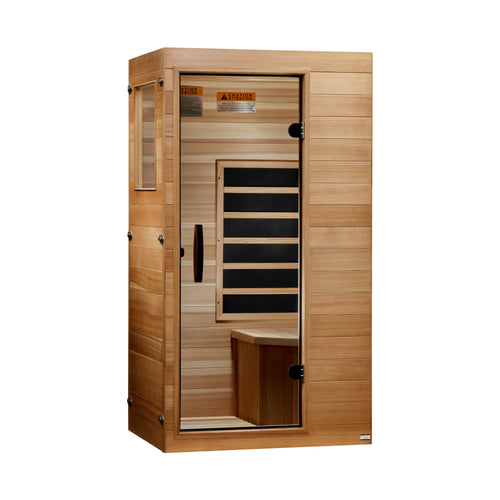

Sauna vs Hot Tub: Cost, Power, Weight and Upkeep, Side by Side
Both put serious heat in your backyard. Where they really differ is what they cost to keep running, what they need underneath and behind the wall, and how much looking after they want. Here are the numbers, from the regulators and the manuals.

The sauna vs hot tub question usually comes up at the same moment: you've decided to put something warm in the backyard, and the budget could stretch to either. We sell saunas and cold plunges, not hot tubs, so take our perspective for what it is. That's exactly why this comparison sticks to figures you can check: the Department of Energy's hot tub analysis, the safety agencies' temperature limits, and the specifications and manuals of the saunas we sell.
The short answer is that a sauna costs less to keep and asks less of you, and a hot tub gives you something a sauna can't: water to float in. The longer answer is below.
The short version
- Running cost: a hot tub keeps its water hot around the clock. DOE's analysis puts a typical baseline hot tub's running cost at more than $500 a year. A sauna draws power only while it's on: at most about $1.46 an hour for an 8 kW stove at 2026's average rate.
- Heat: hot tub water is capped at 104°F by safety guidance. Traditional saunas run at about 170–190°F air, infrared at 118–132°F.
- Weight: a common 300-gallon hot tub carries about 2,500 lb of water alone. The outdoor saunas we sell weigh 409–1,600 lb assembled.
- Upkeep: hot tub water needs sanitizer and pH testing. A sauna has no water system at all.
- Wiring: full-size versions of both are 240V electrician jobs.
Sauna and hot tub, side by side
| Hot tub | Traditional sauna | Infrared sauna | |
|---|---|---|---|
| How it heats you | Immersion in hot water | Hot air from a stove, with steam from water ladled on the stones | Infrared panels warm you directly; the air stays cooler |
| Temperature | Water no hotter than 104°F (CPSC) | About 170–190°F ideal, up to 190–195°F | 118–132°F ideal, up to 140°F |
| Power | Usually 240V; GFCI protection required by the electrical code | 240V, 30–40 A, plus a 120V/15 A control circuit | 120V on a dedicated 15 A circuit |
| When it uses power | All the time, to keep the water hot | Only while switched on | Only while switched on |
| Weight | About 2,500 lb of water in a 300-gallon tub, plus shell and bathers | 409–1,600 lb assembled (our outdoor models) | About 160–305 lb (our 1–2 person cabins) |
| Water care | Sanitizer and pH, tested regularly | None beyond a bucket for the stones | None |
| Indoor option | Possible, with a floor and ventilation built for it | Indoor cabins, 240V | Yes — most are indoor-only |
Sauna figures are the manufacturer's published specifications for the Golden Designs, Dynamic and Maxxus saunas we sell. Hot tub figures are from the Consumer Product Safety Commission, the Department of Energy and the USGS (water at 8.34 lb per gallon); they describe hot tubs generally, not a particular model.
Running cost: why the hot tub costs more to keep
The difference isn't how much power each draws while you use it. It's when they draw it. A hot tub is a large volume of water held at around 100°F day and night, so it loses heat to the air 24 hours a day and the heater keeps replacing it. That's why the Department of Energy measures hot tub efficiency as standby loss, and why its 2025 analysis put a typical baseline hot tub's first-year operating cost at about $569, falling to about $191 for a high-efficiency model.
A sauna starts cold every time. It uses power while it heats up and while you're in it, and then it's off. You can work out your own cost from the heater's rating:
Heater kW × hours switched on × your price per kWh = cost. At the 2026 U.S. average of 18.2¢ per kWh (EIA), every hour of heater time costs 18.2¢ per kilowatt.
| Heater | At most, per hour | 3 sessions a week, 1.5 h each | Typical saunas |
|---|---|---|---|
| Plug-in infrared, 120V/15 A | about 33¢ | about $77 a year | 1–2 person infrared cabins |
| 6 kW traditional stove | about $1.09 | about $255 a year | 2–4 person barrels |
| 8 kW traditional stove | about $1.46 | about $341 a year | Larger barrels, cabins and hybrids |
| Hot tub, DOE baseline | about $569 first-year operating cost (DOE); about $191 for a high-efficiency model | A typical standard hot tub | |
Sauna figures are upper bounds: they assume the heater runs at full rating for every minute it's on, though a thermostat cycles it off once the room is hot. A 120V/15 A circuit can't deliver more than 1,800 watts, which caps any plug-in cabin at 1.8 kW. "1.5 hours" covers preheat plus a session and is our assumption, not a manufacturer figure. Hot tub figures are DOE's national estimates.
Two honest caveats. First, a very efficient hot tub used lightly can cost less than a big outdoor sauna fired up for long sessions several times a week; compare the $191 and $341 lines above. Second, your electricity rate matters more than either: rates vary several-fold between states, so put your own number in the formula. For infrared specifically, our infrared running-cost guide works through more examples.
Power, weight and what goes underneath
Neither is a plug-and-forget purchase at full size, and they ask for different things on installation day.
Hot tub
- Electrical: usually 240V, and the National Electrical Code (Article 680) requires GFCI protection. An electrician's job.
- Load: 300 gallons of water is about 2,500 lb before the shell and the bathers. It needs a base engineered for that — usually a concrete pad, or a deck built for the load.
- Water: filled from a hose, kept sanitized, eventually drained.
Sauna
- Electrical: outdoor traditional and hybrid saunas we sell need 240V at 30 or 40 amps (the traditional models add a 120V/15 A control circuit); the manuals say to consult a certified electrician.
- Load: 409 lb for the 2-person St. Moritz barrel up to about 1,600 lb for a 6-person barn, spread over its footprint. It needs a solid, level, well-drained base.
- Water: none, apart from the bucket you ladle onto the stones.
If an indoor sauna is an option, the wiring question can disappear altogether: a 1–2 person infrared cabin runs on 120V, though the manuals still require it to have a dedicated 15 amp circuit. Our garage and basement sauna guide covers those circuit rules, and the outdoor sauna guide covers bases and weather.
Upkeep: water chemistry vs a damp cloth
A hot tub is a small body of warm water that people sit in, which is an ideal home for bacteria unless it's managed. CDC's guidance for hot tubs is to keep a minimum of 3 ppm free chlorine or 4 ppm bromine, hold the pH between 7.0 and 7.8, and not exceed the manufacturer's upper limits. That means testing, adding chemicals, cleaning or replacing filters, and periodically draining and refilling.
A sauna has no water system. The infrared manuals ask for a wipe-down with water and a soft, damp cloth and no chemical cleaners inside; a traditional sauna adds nothing more than a ladle of water on the stones while you use it. Outdoor wood weathers over time, so follow the care section of your model's manual.
A hot tub asks for a few minutes of water care most weeks. A sauna asks you to wipe the bench.
Heat and safety, briefly
They are different kinds of heat. Hot tub water is limited to 104°F: the Consumer Product Safety Commission's guidance is that it should never go higher, that 100°F is considered safe for healthy adults, and that pregnant women should keep to 100°F because water above 102°F can cause harm early in pregnancy. A traditional sauna runs far hotter air, about 170–190°F on the models we sell, and the Golden Designs manual says not to stay in for more than 40 minutes at a time. An infrared sauna sits between them at 118–132°F.
Whichever you choose, the same advice applies: drink water, keep sessions moderate, and ask your doctor first if you're pregnant or have a heart condition. If you want to know what the research does and doesn't show about regular sauna use, our sauna science guide goes through it study by study.
Which should you choose?
Choose a hot tub if…
- Floating and soaking in water is the point for you
- You picture it as a social space for several people, most evenings
- You're happy to manage water chemistry week to week
- You have, or will build, a base rated for several thousand pounds
Choose a sauna if…
- You want it to cost nothing when you're not using it
- You'd rather not manage water at all
- You want real heat: 170°F and up, or gentler infrared
- You might put it indoors, or want to pair it with a cold plunge
If you're leaning toward a sauna, here's where we'd start: outdoor barrels and cabins, a hybrid that does both kinds of heat, and an indoor infrared cabin if 240V wiring is the sticking point.
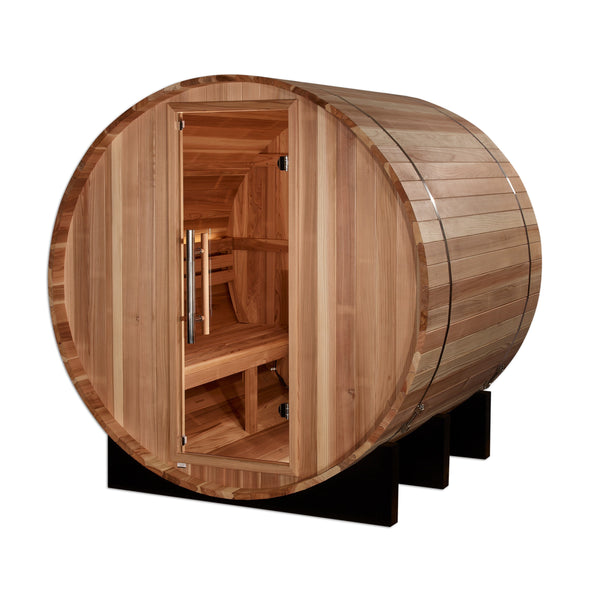 Outdoor barrel for two
Golden Designs St. Moritz
6 kW stove (8 kW optional), 240V, 409 lb assembled.
$5,099View →
Outdoor barrel for two
Golden Designs St. Moritz
6 kW stove (8 kW optional), 240V, 409 lb assembled.
$5,099View →
 The social one
Golden Designs Klosters
6-person outdoor barrel, 8 kW stove, 240V/40 A, 548 lb.
$7,099View →
The social one
Golden Designs Klosters
6-person outdoor barrel, 8 kW stove, 240V/40 A, 548 lb.
$7,099View →
 Outdoor cabin
Golden Designs Arlberg
3-person traditional cabin, 240V/40 A, 715 lb assembled.
$6,099View →
Outdoor cabin
Golden Designs Arlberg
3-person traditional cabin, 240V/40 A, 715 lb assembled.
$6,099View →
 Both kinds of heat
Golden Designs Carinthia
Outdoor hybrid: traditional stove or full-spectrum infrared, 240V/40 A.
$7,099View →
Both kinds of heat
Golden Designs Carinthia
Outdoor hybrid: traditional stove or full-spectrum infrared, 240V/40 A.
$7,099View →
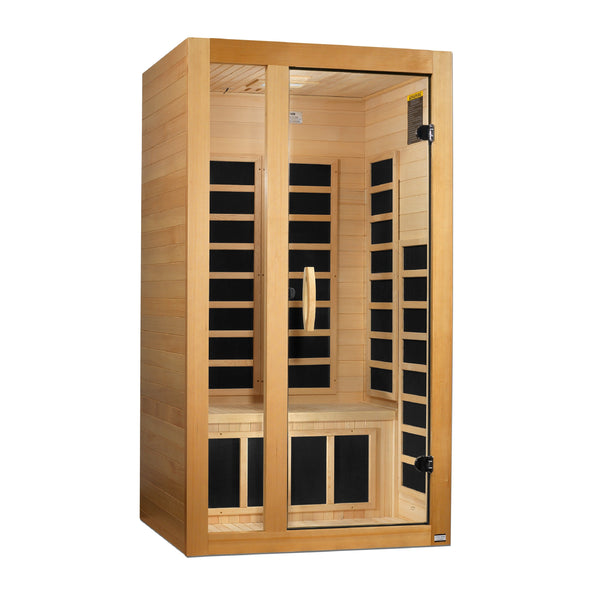 No 240V needed
Dynamic Gracia
Indoor infrared for 1–2, 120V on a dedicated 15 A circuit.
$1,999View →
No 240V needed
Dynamic Gracia
Indoor infrared for 1–2, 120V on a dedicated 15 A circuit.
$1,999View →
 The backyard centrepiece
Golden Designs Kaskinen
6-person barn hybrid, stove plus full-spectrum infrared.
$23,099View →
The backyard centrepiece
Golden Designs Kaskinen
6-person barn hybrid, stove plus full-spectrum infrared.
$23,099View →
Or: a sauna and a cold plunge
Some people who start out comparing a sauna with a hot tub end up with a sauna and a cold plunge instead, alternating hot and cold. Be clear-eyed about it: a cold plunge is a tub of water too, so it needs keeping clean, and models with a chiller use power to hold the temperature. But it's far smaller than a hot tub. Our cold plunges start at $499 for an inflatable tub, and a cedar-clad stainless steel barrel is $3,399; we also sell chillers as separate units. The contrast therapy guide explains how people use the two together.
The warranty, in brief
On the Golden Designs, Dynamic and Maxxus infrared cabins, the written warranty runs 1 to 5 years depending on the part: five years on heating elements and electronics in residential use, one year on the wood structure, parts not labour, for the original purchaser at the original site. Outdoor models carry their own terms, which differ by model, so read the full text on the product page before you choose. It's printed on every one.
Before you order a sauna — the short list
- Decide indoor or outdoor. Indoor infrared avoids 240V wiring; outdoor gives you traditional heat and room for more people.
- Get the electrical quote first: 240V at 30 or 40 amps for outdoor traditional and hybrid models, or a dedicated 120V/15 A circuit for infrared.
- Plan the base: solid, level and well drained, sized to the footprint.
- Check the path from the delivery truck to the spot. Outdoor saunas arrive by freight in several boxes.
- Read the warranty text for the exact model, on its product page.
Tell us where it would go and how many people will use it, and we'll help you weigh it up, including telling you if a hot tub sounds like the better fit.
The Iridescent Home Team
We sell saunas and cold plunges from Golden Designs, Dynamic and Maxxus, and publish the manufacturer's specifications, manuals and warranty text on every product page. We don't sell hot tubs. Call (307) 201-4597, 9am–5pm MT, every day.
Saunas that cost nothing when they're off
Outdoor barrels, cabins and hybrids, plus indoor infrared on 120V. Every one lists its heater, electrical service and assembled weight, so you can plan the install before you buy.
Questions? (307) 201-4597 · 9am–5pm MT, every day
Sauna vs hot tub FAQ
Is a sauna or a hot tub cheaper to run?
How hot is a sauna compared with a hot tub?
Does a sauna need plumbing?
Which is heavier?
Do both need an electrician?
Can I have a sauna and a cold plunge instead?
Sauna temperatures, electrical requirements and weights are the manufacturer's published specifications for the models we sell. Hot tub figures are general, from the U.S. Consumer Product Safety Commission, the Department of Energy's 2025 portable electric spa analysis, CDC guidance and the USGS; individual hot tubs vary. Running costs are estimates from heater ratings and EIA's 2026 average residential electricity price, with the assumptions stated. Electrical work must be done by a licensed electrician to local code. This article is not medical advice. Call (307) 201-4597 with any question before you order.