Dry Sauna vs Steam Room: Which Do You Actually Want?
Same corridor at the gym, completely different experiences — and only one of them is realistic to put in a spare room at home.

At every decent gym there are two doors next to each other, and most people pick one based purely on which handle they reached first. One leads to a dry sauna — hot, wooden, smells faintly of cedar and other people's ambition. The other leads to a steam room, where the air is so thick you could file a missing-person report for whoever went in before you.
They are genuinely different things, and if you're thinking about putting one at home the difference stops being academic very quickly. One is an appliance. The other is a building project. Here's the honest comparison, including the part where we tell you we don't sell one of them.
The core difference is humidity, not heat
People assume the steam room is the hotter one because it feels more punishing. It isn't — not by a long way.
A dry sauna heats the air itself to roughly 150–195°F using a stove and a basket of rocks, with humidity sitting somewhere around 10–20%. Because the air is dry, your sweat evaporates, and evaporation is how your body sheds heat. That's why you can sit in air hot enough to cook in and still feel, broadly, fine.
A steam room runs much cooler — typically 110–120°F — but at 100% humidity, generated by a plumbed steam generator. The air is completely saturated, so your sweat has nowhere to evaporate to. It sits on your skin. That's the heavy, wrapped-in-a-hot-flannel sensation, and it's why a steam room can feel more intense at eighty degrees cooler.
| Dry sauna (traditional) | Steam room | Infrared sauna | |
|---|---|---|---|
| Temperature | 150–195°F | 110–120°F | 110–140°F |
| Humidity | 10–20% | 100% | Low |
| How it heats you | Hot air + radiant rocks | Saturated steam | Directly, by infrared |
| Build type | Self-contained cabin | Tanked, tiled, plumbed room | Self-contained cabin |
| Needs plumbing? | No | Yes — supply and drain | No |
| Typical power | 240V hardwired stove | 240V + water feed | Often a standard outlet |
| Realistic at home? | Yes | Only as a renovation | Yes, easiest of the three |
The steam room is cooler and feels hotter. Once that clicks, the rest of the decision gets much easier.
Wait — is a "dry sauna" just a traditional sauna?
Yes. Dry sauna is simply the everyday name for a traditional Finnish sauna. Same product, same stove, same rocks.
And here's the small irony that trips people up: in a traditional sauna you can ladle water over the hot rocks to produce a sudden burst of steam. The Finns call it löyly, and it's arguably the entire point. So a "dry" sauna isn't reliably dry — it's dry until someone decides otherwise. It's still a world away from a steam room, where the saturation is constant rather than a controllable ten-second event.
The bit that decides it at home: plumbing
This is where the two options separate completely, and it's the reason most home buyers end up with a sauna whether or not they started out wanting one.
A steam room is construction
It needs a fully waterproofed and sealed enclosure, a sloped floor with a drain, a plumbed steam generator with a water supply, tiled or stone surfaces throughout, and ventilation that can handle constantly saturated air. Get the tanking wrong and you don't get a steam room, you get a mould problem inside a wall. This is a contractor job with a contractor's timeline.
A sauna is a cabin you put somewhere
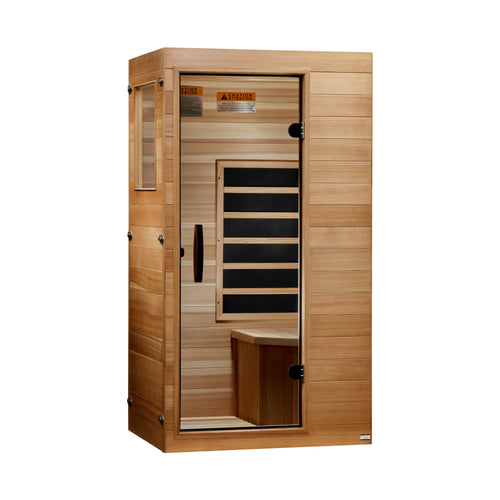
A traditional sauna arrives as a cabin, gets assembled, and needs electrical supply and floor space. No water feed, no drain, no tanking. Outdoor barrel and cabin models are built to live outside year-round. It's closer to buying a large appliance than remodelling a bathroom.
An infrared sauna is easier still
Infrared cabins warm your body directly rather than superheating the air, so they run cooler at 110–140°F and most plug into an ordinary household outlet — no electrician, no dedicated circuit. That's why they're the most common first home sauna, starting at $1,499.
We should be straightforward about our own position here: we sell saunas, not steam rooms. If after reading this you decide a steam room is what you want, you'll need a bathroom contractor rather than us, and that's a perfectly good outcome. We'd rather you got the right thing.
So which one suits you?
Strip away the marketing and it comes down to how you like heat, and what you're willing to build.
A sauna suits you if
- You want it installed in weeks, not months
- You like dry heat you can sit in and read
- You want the option of steam on demand, via the rocks
- You'd rather not tank and drain a room
- You want it outdoors, or in a garage or spare room
- You may want to take it with you if you move
A steam room suits you if
- You find humid heat easier on your airways than dry
- You're already renovating a bathroom anyway
- You want the enveloping, heavy-air sensation specifically
- You have the budget and appetite for a build
- You don't need to move it, ever
If you're leaning sauna but unsure between traditional and infrared, that's a genuinely different question and we've written it up separately in infrared vs traditional saunas. The short version: infrared for gentler, cheaper, plug-in convenience; traditional for the authentic high-heat ritual.
What about the benefits?
Both apply heat, and many people find heat helps them relax, unwind after a hard day, and loosen stiff muscles after exercise. Dry saunas reach higher air temperatures and are the more common post-workout choice; steam rooms are often preferred by people who find humid air easier to breathe.
We'd gently steer you away from anyone making dramatic claims for either. The honest position is that both are pleasant, both are widely used, and the one that helps you most is the one you'll still be using in six months. Convenience beats theory every time — which, practically speaking, favours whichever one is twenty feet from your sofa.
The quick decision
- Want it at home without building work? Sauna. Infrared if you'd rather avoid an electrician; traditional if you want the real high-heat ritual.
- Already gutting a bathroom? A steam room becomes realistic — talk to your contractor early about drainage and tanking.
- Not sure which heat you prefer? Use both at a gym or spa a few times before spending anything. It's the cheapest research you'll ever do.
- Want both? A traditional sauna with water on the rocks gets you closer than most people expect.
Our traditional cabins start at $5,099 and infrared starts at $1,499, all with free shipping and the manufacturer's warranty — terms differ by model and are printed on each listing. If you want to talk it through before deciding, that's what the phone number is for.
The Iridescent Home Team
Authorized dealer for Dynamic, Maxxus & Golden Designs. We sell traditional and infrared saunas — not steam rooms — and we'll tell you plainly when the thing you want isn't what we stock. Questions? Call (307) 201-4597.
Dry heat, without the building work
Traditional Finnish cabins from $5,099, infrared from $1,499. No plumbing, no tanking, no drain — just floor space and power. Free shipping, 5-year manufacturer warranty, and financing available at checkout.
Questions? (307) 201-4597 · 9am–5pm MT, every day
Dry sauna vs steam room FAQ
What is the difference between a dry sauna and a steam room?
Is a dry sauna the same as a traditional sauna?
Can you install a steam room at home?
Which is better for sore muscles?
This article is general wellness information, not medical advice, and has not been evaluated to diagnose, treat, cure, or prevent any disease. Consult your healthcare provider before starting sauna or steam use, especially if you are pregnant or have a medical condition. Prices are current as of publication and may change.